
The Macro Production Landscape: Where Scott County Wins
Evaluating the volume of film and media production activity that Scott County, Kentucky, can realistically capture requires an empirical breakdown of the wider American entertainment production market. The domestic production ecosystem is heavily tiered, spanning multi-hundred-million-dollar studio tentpoles, mid-tier theatrical releases, independent narrative features, broadcast and cable television movies, streaming series, documentaries, and high-end commercial campaigns.
At the highest echelon of the domestic market, major theatrical releases produced by legacy studios and major mini-majors typically fluctuate between 500 and 700 titles during normalized release cycles, down from historical peaks in the late 2010s when domestic releases approached 900 to 1,000 titles prior to theatrical consolidation and streaming realignment.[1,2] Global analytical datasets tracked by the World Intellectual Property Organization (WIPO) and Omdia indicate that while worldwide feature film production reached a record volume of 9,628 projects, the United States accounted for 544 primary theatrical feature films in 2024.[3]
However, theatrical releases capture only a fraction of total narrative motion picture activity in the United States. A substantial volume of narrative features operates below the theatrical line—encompassing independent features, direct-to-streaming original films across Netflix, Amazon MGM Studios, Apple TV+, and Hulu, alongside made-for-television movies (MOWs) produced for basic-cable networks like Hallmark, Lifetime, and Great American Family, as well as digital VOD pipelines.[4,5] When aggregating these sub-theatrical narrative features, the domestic volume of completed feature films expands to between 2,800 and 3,500 projects per year.[4] When further factoring in episodic television drama, unscripted docuseries, and national commercial campaigns, the aggregate universe of camera-ready, incentive-seeking media productions exceeds 4,500 projects annually.[4]
Why We Target the $1M–$10M "Sweet Spot" (800–1,200 Films/Yr)
Scott County is not structured to host $150M studio tentpoles requiring cavernous deep-water VFX tanks and 500-person union stage crews.[8]
Instead, our prime addressable market is concentrated in Tier 3 Independent Features ($1M–$14M; 800–1,200/yr), Tier 4 Micro-Budget Features, and High-End Commercials & LEX Studios Split Shoots.[7,9,11] These productions avoid expensive studio leases and actively relocate for 30%–35% cash-back tax credits, authentic practical locations, and <72-hour local permitting.[6,14]
National Production Volume & Geographical Relocatability by Tier
| Production Tier | Typical Budget Band | Est. Annual US Volume | Primary Capital & Infrastructure Drivers | Geographical Relocatability & Scott County Fit |
|---|---|---|---|---|
| Tier 1: Major Studio Tentpole Feature | $75,000,000 – $250,000,000+ | 80 – 110 projects | Purpose-built soundstages, massive deep-water/VFX tanks, expansive tier-one union crews, post pipelines[8] | Low Tied to primary hubs (LA, Atlanta, London, NYC)[8] |
| Tier 2: Mid-Budget Studio & Streamer Feature | $15,000,000 – $74,000,000 | 180 – 250 projects | Competitive statutory tax credits, soundstage infrastructure, certified payroll density, multi-unit crew depth[8] | Moderate Secondary split-unit exterior days via KY hubs[8] |
|
Prime Target #1 Tier 3: Core Independent Feature & Cable MOW |
$1,000,000 – $14,000,000 | 800 – 1,200 projects | Refundable cash-back tax incentives (30%–35%), authentic practical locations, turnkey permitting, low overhead[9] | High Actively relocates for KEI 35% yield & <72-hr permits[10] |
|
Prime Target #2 Tier 4: Micro-Budget Independent & Genre VOD |
$150,000 – $999,000 | 1,500 – 2,000+ projects | Low-cost permitting, practical physical locations, accessible non-union/student crew, affordable I-75 lodging[4] | Very High Moves fluidly toward KY's low $125k–$250k spend floors[4,12] |
|
Prime Target #3 High-End Commercials, Branded & Episodic Units |
$200,000 – $3,000,000 | 1,200 – 1,800 campaigns | Distinctive architectural or equine/pastoral landscapes, automotive hubs (Toyota/TMMK), rapid municipal permits[6] | High Driven by LEX Studios proximity & I-75/I-64 access[7,14] |
The Commonwealth Ecosystem: $75M KEI Rebate & Regional Trajectory
Kentucky has established one of the most commercially aggressive production incentive structures in the United States.[6] Governed by Kentucky Revised Statutes Chapter 154 (KRS 154.61 / KRS 148.542–148.546) and codified under administrative regulations (307 KAR 1:080E), the Commonwealth operates the Kentucky Entertainment Incentive (KEI) program, overseen by the Kentucky Cabinet for Economic Development and administered via the Kentucky Film Leadership Council (KFLC).[6]
Unlike transferable film tax credit programs in states such as Georgia or Louisiana—where visiting production entities must sell earned tax certificates to third-party corporate buyers through specialized brokers at discounted rates ranging from 82 to 88 cents on the dollar—the Kentucky incentive functions as a 100% fully refundable, non-transferable cash tax credit.[7] Following completion of a certified cost audit by a licensed Kentucky CPA, the Commonwealth issues a direct cash refund from State Treasury balances.[7]
The State of Kentucky pays 100% of this 30%–35% cash rebate out of its statutory state allocation—meaning local taxpayers in Georgetown and Scott County contribute $0 in municipal dollars toward producer tax incentives while capturing 100% of local room taxes, payroll taxes, and vendor spending.[14]
Proven Statewide & Central Kentucky Demand: Since the relaunch of the modern KEI framework, the program has incentivized more than 270 productions statewide, generating over $795 million in direct in-state qualified expenditures and creating over 27,000 production-related jobs.[19] By the Kentucky Film Leadership Council's October 2026 allocation session, 81 media projects had been approved year-to-date, representing $58,761,582 in allocated tax credits against the state's $75,000,000 annual ceiling.[22]
Central Kentucky has capitalized rapidly on this momentum.[25] In late 2024, VisitLEX launched FilmLEX, headed by industry veteran Lisa Brin, targeting the $1,000,000 to $10,000,000 budget sweet spot.[9,11] In its initial operational cycle, FilmLEX assisted 17 projects utilizing the state incentive within Fayette County, facilitating more than $27 million in approved Central Kentucky production expenditures.[25]
The LEX Studios Backlot Advantage
Central Kentucky's soundstage capacity is anchored by LEX Studios in Lexington (owned by Wrigley Media Group)—a 50,000-square-foot dedicated production facility featuring:[14,15,28]
- 3 Purpose-Built Soundstages: Spanning 81′×70′, 72′×58′, and 70′×48′ for controlled interior sets.
- 35,000 Sq Ft Mill & Flex Space: Construction workshops, production offices, grip/electric packages, and 9 Avid post-production suites.
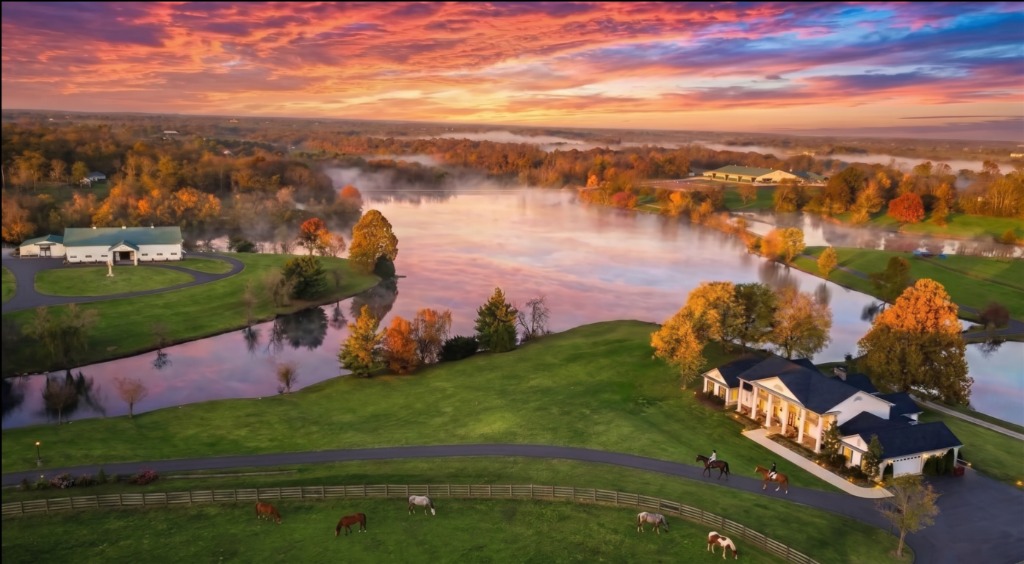
- Zero Need for Scott County Taxpayers to Build Soundstages: Positioned 15–20 minutes north along I-75/I-64, Scott County serves as the dedicated practical exterior backlot (horse farms, Victorian Main Street, antebellum villas, 40-acre lake, Bourbon rickhouses) for productions staging interiors at LEX Studios.[14]
Statutory Parameters of the Kentucky Entertainment Incentive (KEI)
| Statutory Parameter | Standard KY County | Enhanced / Heritage Rate | Legislative Mandate & Operational Rules |
|---|---|---|---|
| Qualified Local Goods & Services Spend | 30% Refundable Credit | 35% Refundable Credit | Covers equipment rentals, lumber, site/location fees, local vendors, catering, and hotel blocks[7] |
| Non-Resident Below-The-Line (BTL) Payroll | 30% Refundable Credit | 35% Refundable Credit | Eliminates regional labor recruitment penalties for visiting department heads[7] |
| Kentucky-Resident Labor (ATL & BTL) | 35% Refundable Credit | 35% Refundable Credit | Statutory 5% uplift in all counties to incentivize hiring local technicians, PAs, and talent[6] |
| Minimum Spend Floor (Out-of-State Entity) | $250k–$400k Feature ($200k Comm / $20k Doc) | $250k–$400k Feature ($200k Comm / $20k Doc) | Accessible threshold for out-of-state entities producing features, TV, or commercials[12] |
| Minimum Spend Floor (KY-Based Entity) | $125k–$200k Feature ($100k Comm / $10k Doc) | $125k–$200k Feature ($100k Comm / $10k Doc) | 50% reduced spend floor incentivizing Kentucky-registered production companies[12] |
| Above-The-Line (ATL) Compensation Cap | $1,000,000 per person | $1,000,000 per person | Caps qualifying tax credit calculation on principal directors, writers, and lead performers[7] |
| Continuous Production Threshold ($10M+) | 35% Across All Spend | 35% Across All Spend | Full 35% rate applies in standard counties if cumulative in-state spend reaches $10M+[12] |
| Annual Program Funding Ceiling | $75,000,000 Statewide Cap | $75,000,000 Statewide Cap | Statutory state treasury pool distributed through regular KFLC board cycles ($0 local cost)[6,22] |
Scott County's 7 Physical Filming Sectors & Operational Architecture
The ability of Scott County to attract production spend depends on connecting its physical location assets with an institutional film office framework.[14] Across Georgetown, Sadieville, Stamping Ground, and Oxford, the county's physical filming assets span seven primary on-camera sectors paired with local hospitality, crew, and vendor services—all enrolled at $0 cost under the open-access directory and Mandatory 3-Property Competitive Pitch Rule (Explore the Location Directory).[14,29]
Scott County Location & Asset Sectors Across All Municipalities
| Scott County Asset Sector | Primary Physical Backdrops | Practical Production Utility | Regional Strategic Value |
|---|---|---|---|
| 1. Equine Estates & Working Ranches | Old Friends Thoroughbred Retirement, Iron Works Pike & Paris Pike farms, and gated 140+ acre equine estates with indoor arenas[14] | Period equestrian scenes, Western/rural doubles, 20–50 vehicle basecamps, AXXIS LED virtual production[14] | Turnkey open acreage & heavy truck parking 15 minutes north of LEX Studios[14] |
| 2. Historic & Antebellum Architecture | Ward Hall (1857 Greek Revival villa, 12,000 sq ft, 27-ft Corinthian columns), private historic estates[14] | Antebellum, Southern Gothic, Civil War, and Gilded Age period dramas[14] | Monumental preserved estate architecture unavailable inside urban soundstages[14] |
| 3. Civic Townscapes & Historic Downtowns | Downtown Georgetown Victorian Main Street, 1877 Courthouse Square, Sadieville & Stamping Ground[14] | Classic Americana streetscapes, holiday cable MOWs, small-town Main Street & courtrooms[14] | High architectural density suitable for intermittent traffic control & street closures[14] |
| 4. Academic & Collegiate Campus | Georgetown College (founded 1829; antebellum brick quad, lecture halls, athletic fields)[14] | Ivy League, Midwestern, or historic collegiate sets; theatre/media arts student crew pipeline[14] | Feeds trained student Production Assistants into shoots under 35% resident payroll credits[7,14] |
| 5. Industrial, Automotive & Logistics | Toyota Motor Manufacturing KY (8.1M sq ft complex), Lanes Run Business Park, active rail spurs[14] | National automotive launches, commercial campaigns, corporate video, modern industrial sets[14] | Anchors high-day-rate commercial and industrial corporate productions in Central KY[14] |
| 6. Bourbon Heritage & Distilleries | Historic craft distilleries, timber aging rickhouses, copper stills, limestone springhouses[14] | Kentucky Bourbon Trail lifestyle series, period Prohibition dramas, spirits commercials[14] | Authentic operational distilling facilities with private landowner opt-ins[14] |
| 7. Waterways, Topography & Nature | 40-acre spring-fed private lake, Elkhorn Creek limestone bluffs, Royal Spring Park, Yuko-En Garden[14] | Marine water shoots, unblemished 360° drone horizons, secluded nature doubles[14] | Controlled water horizon with zero public boat traffic or wake interference[14] |
Quantitative Capture Modeling: $2.7M to $10.0M+ Annual Local Spend
Central Kentucky currently captures between 15 and 25 KEI-approved productions annually—a baseline projected to expand to 30 to 40 projects as LEX Studios reaches full operational capacity and regional crew bases deepen.[22,25] Under full operational readiness, an active Georgetown/Scott County Film Office can realistically secure a substantial share of this regional activity across four defined production segments:[14]
Primary Independent Features ($1M–$5M Budgets)
Utilize Scott County as their principal photography base across horse farms, downtown corridors, and historic estates for 12 to 24 camera days. Each film injects $800,000 to $2,200,000 in direct local expenditures and fills Georgetown hotels/B&Bs with 600 to 1,400 room nights across prep, shoot, and wrap.[9,14]
LEX Studios & Regional Split-Location Shoots
Productions staging interior sets at LEX Studios (15 minutes south) frequently require 2 to 6 shooting days on practical exterior locations (manor homes, bourbon rickhouses, open-water lakes, rural roads). Each split shoot injects $150,000 to $450,000 directly into Scott County location fees, police details, catering, and room nights.[14]
Commercial, Automotive & Branded Media
National agencies and corporate media teams executing automotive launches, Bourbon lifestyle campaigns, or industrial ads operate on fast 1 to 4 day schedules, generating $40,000 to $175,000 per shoot with premium daily location fees paid directly to local property owners.[14]
Episodic TV, Documentaries & Unscripted Series
Specialized docuseries and unscripted television focused on Kentucky Bourbon heritage, Thoroughbred horse racing, collegiate sports, or historical narratives stay 3 to 10 days, generating $50,000 to $300,000 per project in local lodging, dining, and vendor spend.[6,7]
Realistic Annual Production Projections for Scott County (Full Readiness)
| Production Classification | Projected Annual Volume | Avg. Local Shoot Duration | Local Direct Spend Range (Annual Aggregate) | Scott County Hotel / B&B Room Night Yield |
|---|---|---|---|---|
| Primary Independent Features ($1M–$5M) | 2 – 4 productions | 12 – 24 shooting days | $1,600,000 – $6,000,000 | 1,200 – 3,200 room nights |
| LEX Studios / Regional Split Shoots | 5 – 8 productions | 2 – 6 shooting days | $750,000 – $2,500,000 | 400 – 1,200 room nights |
| Commercial / Automotive / Branded | 4 – 7 productions | 1 – 4 shooting days | $200,000 – $700,000 | 80 – 300 room nights |
| Episodic, Documentaries & Unscripted | 2 – 4 productions | 3 – 10 shooting days | $150,000 – $800,000 | 150 – 500 room nights |
| Total Comprehensive Capture Baseline | 13 – 23 productions | 35 – 80 total shoot days | $2,700,000 – $10,000,000+ | 1,830 – 5,200 room nights |
Comparative Assessment: Without vs. With a Dedicated Film Office
The central policy consideration for the Mayor of Georgetown, the Scott County Fiscal Court, and the Tourism Commission is establishing the measurable difference between maintaining the status quo (operating without a dedicated film office) and implementing the structured Georgetown/Scott County Film Office blueprint.[14] Industry case studies and regional data demonstrate that operating without an institutional film commission creates three structural bottlenecks that lock a municipality out of the production economy:[14,17,30]
14–30 Day Permitting Paralysis
Pre-production windows run just 4–8 weeks.[12] Without a central film desk, producers must submit separate, uncoordinated applications to City Police, County Sheriff, Fire/EMS, Public Works, and Parks—taking 2 to 4 weeks and forcing shoots to relocate to film-ready counties.[14]
The Inbound Scouting Vacuum
When producers at LEX Studios need an antebellum villa, 40-acre lake, or bourbon rickhouse, general municipal reception desks lack location lookbooks or technical specs (basecamp turning radiuses, 3-phase power)—sending budgets to Fayette, Clark, Franklin, or Woodford counties.[14]
Hotel & Catering Leakage to Lexington
Even when an unassisted shoot films an isolated exterior scene in Scott County, the crew sleeps in Lexington hotels, books urban caterers, and rents metro hardware—leaving Scott County with traffic disruption and virtually zero room tax revenue.[14]
Side-by-Side Economic & Operational Comparison
| Performance & Operational Metric | Without Film Office (Status Quo) | With Film Office (GSCFO Blueprint) | Net Differential (The Commission Delta) |
|---|---|---|---|
| Annual Primary Feature Films ($1M–$5M) | 0 – 1 production (unassisted, irregular) | 2 – 4 productions (actively recruited & serviced) | +2 to +3 primary feature films |
| Annual Split-Location / Backlot Shoots | 0 – 1 production (isolated b-roll crews) | 5 – 8 productions (formal LEX Studios link) | +5 to +7 regional split shoots |
| Annual Commercial & Branded Shoots | 0 – 2 productions (locally initiated only) | 4 – 7 productions (national automotive & brands) | +3 to +5 commercial campaigns |
| Annual Episodic & Documentary Projects | 0 – 1 production (untracked) | 2 – 4 productions (formal concierge intake) | +2 to +3 episodic projects |
| Total Annual Film & Media Productions | 0 – 2 productions / yr | 8 – 15+ (up to 23) productions / yr | +7 to +13+ total productions annually |
| Municipal Permitting SLA Turnaround | 14 – 30 days (uncoordinated multi-agency) | < 72 business hours (central digital desk) | 10 to 27 days faster permit issuance |
| Initial Location Lookbook Delivery | Unavailable / Ad-hoc general inquiries | < 24 hours (minimum 3 local options) | Immediate entry into studio bidding |
| Annual Scott County Hotel & B&B Nights | 0 – 150 nights (extreme leakage to Lexington) | 1,200 – 3,500+ (up to 5,200) nights retained | +1,050 to +3,350+ local room nights |
| Annual Qualified Local Spend Retention | $25,000 – $250,000 (incidental) | $3,500,000 – $10,000,000+ direct spend | +$3,250,000 to +$9,750,000+ local injection |
| Local 3% Transient Room Tax Revenue | Negligible (<$1,500 annually) | $15,000 – $45,000+ generated annually | Directly offsets municipal commission desk[14] |
| Local Merchant & Property Inclusion | 0 (Unlisted, private ad-hoc only) | 100+ enrolled local businesses & farms ($0 fee) | Equal-access community revenue sharing[14] |
Production Capital Does Not Allocate Automatically to Picturesque Landscapes
Film dollars migrate exclusively to communities offering professional <72-hour permitting systems, organized 3-option location lookbooks within 24 hours, and rapid municipal coordination.[14] Because the Georgetown/Scott County Film Office operates on a lean, self-funding allocation with $0 commercial lease overhead and $0 W-2 pension/benefit liability, the blueprint requires zero tax increases while positioning Scott County to capture $3,500,000 to $10,000,000+ in annual direct local spend.[14]
Works Cited & Primary Data Sources (1–32)
- Motion Picture Association, Motion Picture Association Celebrates Its 100th Anniversary (mpa100.org).
- Wikipedia / MPA Theatrical Market Statistics, Cinema of the United States (en.wikipedia.org).
- World Intellectual Property Organization (WIPO) & Omdia, Lights, Camera, Records: Global Film Production Hits a Record (wipo.int).
- Independent & Sub-Theatrical Production Volume Analysis, Domestic Feature & Streaming Pipeline (Source Link).
- Global & Domestic Annual Film Output Benchmark (Source Link).
- Kentucky Film Office / Cabinet for Economic Development, Film Kentucky Incentives (KRS 154.61 / 307 KAR 1:080E) (filmkentucky.org/Incentives).
- Vensure Entertainment Payroll, Kentucky Film Tax Incentives Guide (vensure.com).
- FilmLA Research, Feature Film Production Study (filmla.com).
- WUKY Public Radio, FilmLEX Shoots for Bigger Film Industry Presence in Lexington (wuky.org).
- Cast & Crew Entertainment Services, U.S. Tax Incentive Program (TIP) Guide (castandcrew.com).
- VisitLEX Official Press Release, Lexington, Kentucky Seeking Productions of Up to $10 Million With State Tax Credit (visitlex.com).
- Storiara Production Incentives, Kentucky Film Tax Credit Statutory Breakdown (storiara.com).
- WLRN Public Media, Regional Film Industry Incentives & Municipal Grants Analysis (wlrn.org).
- John Chmela / Queenslake Horse Farm, Georgetown & Scott County Film Office Master Feasibility Blueprint (queenslake.com/film-office).
- Wrigley Media Group, Regional Production & Post-Production Capabilities (wrigleymediagroup.com).
- VisitLEX / FilmLEX, Official FilmLEX Launch & Economic Impact Announcement (PDF Report).
- Wrapbook Production Payroll, How Film Commissions Shape Our On-Screen Stories & Local Economies (wrapbook.com).
- KYfilm.org, Kentucky Entertainment Incentive Overview (kyfilm.org/incentives).
- Commonwealth of Kentucky / Cabinet for Economic Development, Film and Production Teams Encouraged To Apply for State Support ($795M+ Impact) (newkentuckyhome.ky.gov).
- Entertainment Partners (EP), KY Film Tax Credits and Incentives (ep.com).
- Kentucky Film Office Official Portal (filmkentucky.org).
- Kentucky Economic Development Finance Authority / KFLC, KFLC Board Allocation Report ($58,761,582 Across 81 Projects) (cedky.com).
- Site Selection Magazine, FILM & ENTERTAINMENT: The Rise of Kentucky-Based Film & TV (siteselection.com).
- Screen Global Production, Kentucky Film Incentive Demand Approaching $75M Annual Ceiling (screenglobalproduction.com).
- 6AM City / LEXtoday, FilmLEX Introduced to Bring More Entertainment Projects to Lexington (17 Projects / $27M+ Spend) (6amcity.com).
- Kentucky Senate Majority Caucus, Kentucky General Assembly's Investment in Film and TV Industry Celebrated (kysenaterepublicans.com).
- VisitLEX Convention & Visitors Bureau, About VisitLEX Regional Tourism (visitlex.com).
- LEX Studios Official Facility Specifications, 50,000 Sq Ft Soundstage & Post-Production Overview (lexstudios.tv).
- Georgetown & Scott County Film Location & Business Directory (queenslake.com/film-directory.html).
- Bowling Green State University ScholarWorks, Developing a Municipal Location Filming Program (scholarworks.bgsu.edu).
- Queenslake Horse Farm, 140-Acre Equine Estate, 40-Acre Lake & Production Infrastructure (queenslake.com/activities.html).
- BarrieToday Municipal Film Commission Case Study, Study Makes Case for Attracting Film Production to Regional Municipalities (barrietoday.com).